

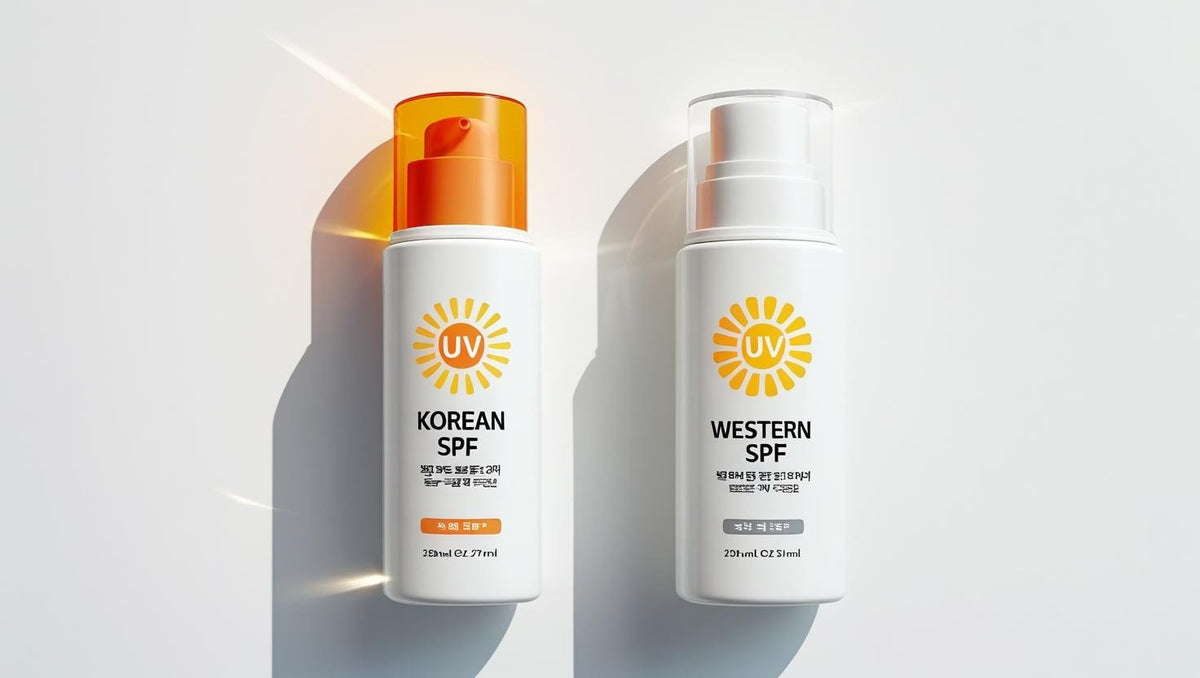
Difference Between Korean SPF vs Western SPF
Quick Summary: Korean SPF and Western SPF are not the same. Korean sunscreens use superior UV filters (Tinosorb, Uvinul, Mexoryl), a more precise PA++++ UVA rating system, and lightweight textures designed for Asian humidity — making them far better suited for Pakistan's UV Index 10–12 summers and South Asian complexions. This guide explains every key difference.
If you've ever wondered why your expensive imported Western sunscreen feels heavy, leaves a grey cast, or causes breakouts while a Korean SPF goes on invisibly and feels like skincare — the answer lies in the chemistry of UV filtration, regulatory differences between countries, and 20 years of Korean cosmetic innovation specifically targeting Asian skin conditions. For Pakistani consumers choosing sun protection in one of South Asia's highest UV environments, understanding Korean SPF versus Western SPF is not just interesting — it directly affects your skin health. Korean Skincare Pakistan stocks a full range of Korean SPF 50+ PA++++ formulas, all available with COD nationwide.
UV Filter Ingredients: The Core Difference Between Korean and Western SPF
The most fundamental difference between Korean and Western sunscreens is which UV-blocking chemical ingredients they use. In the United States, the FDA has only approved 16 UV filters — and many of these have not been reviewed since the 1970s. More critically, several highly effective modern UV filters used in Korean products are not FDA-approved, meaning American sunscreen brands cannot use them even if they wanted to.
Korean sunscreens, regulated by MFDS (Ministry of Food and Drug Safety), can use next-generation UV filters including Tinosorb S (bis-ethylhexyloxyphenol methoxyphenyl triazine), Tinosorb M, Uvinul A Plus, and Mexoryl SX. These filters are photostable — meaning they don't break down under sunlight — and provide broader, more even UVA coverage at lower concentrations. Lower active concentrations mean less of the heavy emollients needed to dissolve them, which translates directly into the lighter, more breathable textures that Korean sunscreens are known for. For Pakistani oily skin in 40°C Lahore summers, this difference is the difference between wearing SPF and skipping it because it feels unbearable.
The PA Rating System: How Korea Measures UVA Protection Better
Western sunscreens use only SPF (Sun Protection Factor) as their primary metric, with "broad spectrum" as a binary pass/fail indicator of UVA coverage. This system tells you almost nothing about how much UVA protection you're actually getting. Korean sunscreens use both SPF for UVB and a PA (Protection Grade of UVA) system that scales from PA+ (modest UVA protection) to PA++++ (maximum UVA protection, UVA-PF of 16+).
UVA is the primary cause of hyperpigmentation, photoaging, and deep structural skin damage. It penetrates through clouds and glass — meaning on overcast days in Islamabad, or sitting near an office window in Karachi, you're still receiving significant UVA exposure. Pakistan's latitude means UVA levels remain relatively high year-round compared to European countries where Western SPF standards were designed. PA++++ is the only rating that provides adequate UVA protection for Pakistani sun exposure, especially for darker South Asian complexions more prone to UVA-triggered melanin overproduction.
Texture, Finish, and White Cast: Why Korean SPF Wins for South Asian Skin
Western mineral sunscreens typically use zinc oxide or titanium dioxide at 10–20% concentrations. These particles scatter light broadly and effectively but create significant white cast on medium-to-dark skin tones — the NC30+ range common across Pakistan. Korean physical sunscreens use micronised zinc oxide at lower concentrations with tone-adjusting pigments that neutralise the white cast, producing a translucent or colour-correcting finish.
Korean chemical sunscreens use UV filters (Tinosorb, Uvinul) that are colourless and transparent at the concentrations needed for SPF50+ protection, making white cast a non-issue entirely. The formulation vehicles — the textures around the UV filters — in Korean sunscreens are engineered for humid, hot Asian climates. Aqua-gel bases, oil-free emulsions, and serum-type carriers create textures that feel like water on oily Pakistani skin in summer, absorb in under 60 seconds, and don't transfer onto masks or phone screens.
Korean SPF vs Western SPF: Full Comparison for Pakistan
| Feature | Korean SPF | Western/American SPF |
|---|---|---|
| UV Filters Available | 28+ (incl. Tinosorb, Uvinul, Mexoryl) | 16 (many outdated) |
| UVA Measurement | PA++++ (granular, precise) | "Broad Spectrum" (pass/fail) |
| Photostability | High (modern filters) | Variable (avobenzone degrades) |
| Texture for Humid Climate | Aqua-gel, serum, stick | Typically cream (designed for dry climates) |
| White Cast on NC30+ Skin | Minimal to none | Common (zinc/titanium) |
| Suitable for Pakistan UV (10-12) | Yes — PA++++ standard | Partial — UVA coverage often lower |
Top Korean SPF Formulas for Pakistani Skin

Beauty of Joseon
Beauty of Joseon Relief Sun SPF50+ PA++++ Rice & Probiotics 50ml
The gold standard of Korean SPF in Pakistan — Tinosorb-based filtration with probiotic and rice extracts, zero white cast on South Asian complexions, perfect for daily use in Lahore and Karachi.
PKR 5,250
Shop Now →
SKIN1004
SKIN1004 Madagascar Centella Tone Brightening Tone-Up Sunscreen SPF50+ PA++++
Brightening SPF that colour-corrects dullness while delivering full PA++++ UVA coverage — replaces both primer and sunscreen in a single step for Islamabad professionals.
PKR 5,780
Shop Now →
SOME BY MI
SOME BY MI V10 HYAL Air Fit Sunscreen SPF50+ PA++++ 50ml
The lightest Korean SPF available in Pakistan — air-fit formula vanishes on skin and hyaluronic acid provides hydration alongside UV protection, making it ideal for Multan's dry heat.
PKR 5,950
Shop Now →Frequently Asked Questions
Why does Western SPF leave a white cast but Korean SPF doesn't on Pakistani skin?
Western physical sunscreens rely on high concentrations of zinc oxide or titanium dioxide which scatter visible light — creating white cast on NC30+ skin tones common in Pakistan. Korean chemical sunscreens use transparent UV filters (Tinosorb, Uvinul) that absorb UV without scattering visible light, producing zero white cast.
Is PA++++ actually better than "broad spectrum" for Pakistan?
Yes, significantly. PA++++ requires a measured UVA Protection Factor of 16+ — a specific, quantified level of UVA protection. "Broad spectrum" only requires that the product provides some UVA protection greater than a threshold — it says nothing about how much. For Pakistan's high UVA environment, the difference between a barely-broad-spectrum SPF 50 and a PA++++ product is clinically meaningful for long-term skin health.
Where can I buy Korean SPF 50+ PA++++ in Pakistan with COD?
Korean Skincare Pakistan (korean-skincare.pk) stocks all major Korean SPF 50+ PA++++ formulas with COD in Lahore, Karachi, Islamabad, Rawalpindi, Multan, Peshawar, Faisalabad, and Quetta. Delivery takes 5–7 business days from Seoul. Free shipping on orders over PKR 6,000.
Can I trust SPF claims on Korean sunscreens bought in Pakistan?
Yes — when purchased from an authorised retailer like korean-skincare.pk. Korean MFDS testing standards are rigorous. Products from korean-skincare.pk ship directly from Seoul with batch verification available on checkfresh.com. Counterfeit Korean sunscreens on Daraz may not deliver their claimed SPF or PA ratings.
Do Korean sunscreens protect against both UVA and UVB in Pakistan's conditions?
Yes — all Korean sunscreens rated SPF 50+ PA++++ protect against both UVB (the burning ray) and UVA (the aging and pigmentation ray). This dual protection is essential in Pakistan where both types of UV radiation are intense. Use PA++++ year-round, not just in summer, as UVA levels remain elevated even in winter months in Karachi and Lahore.
